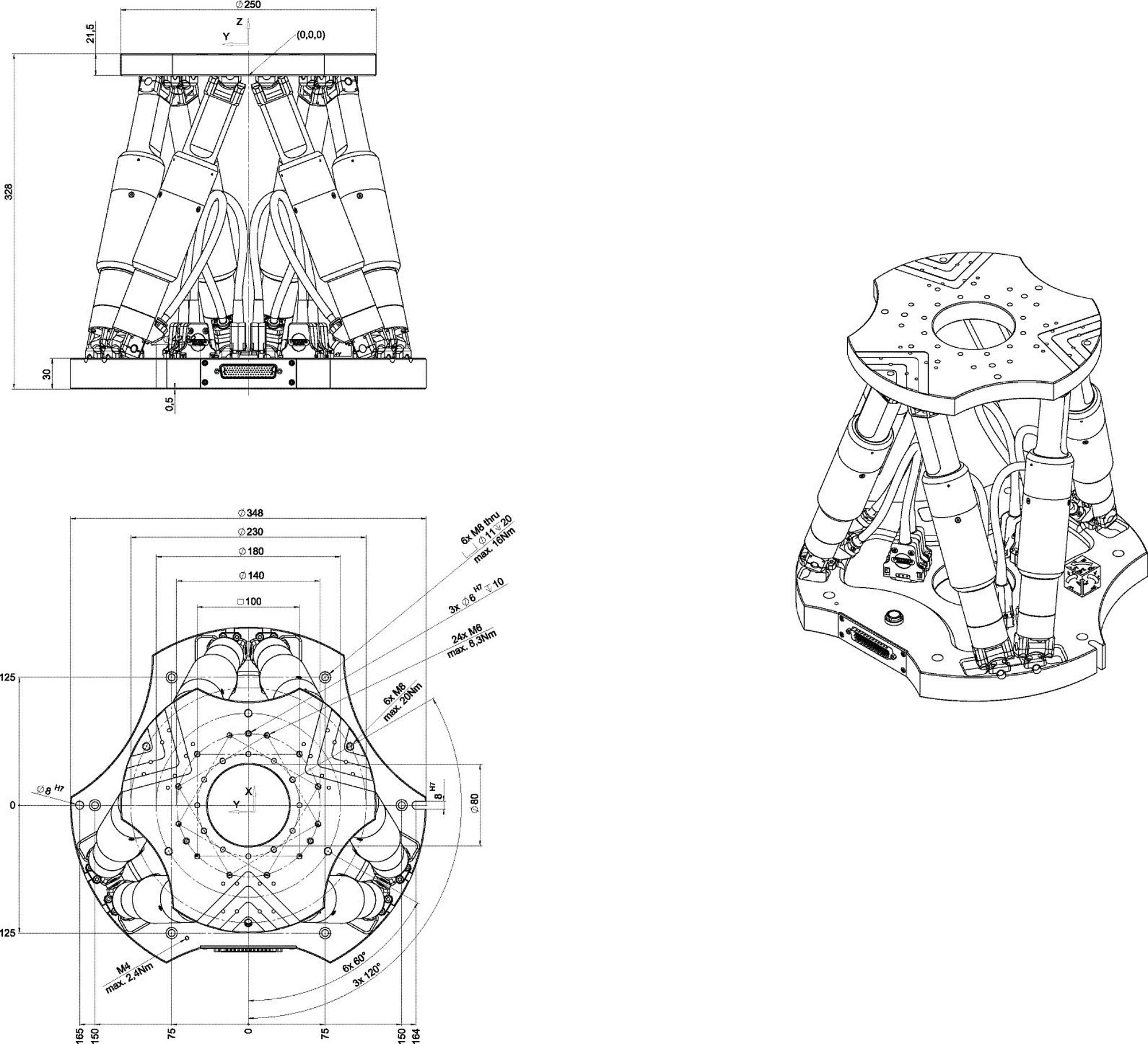
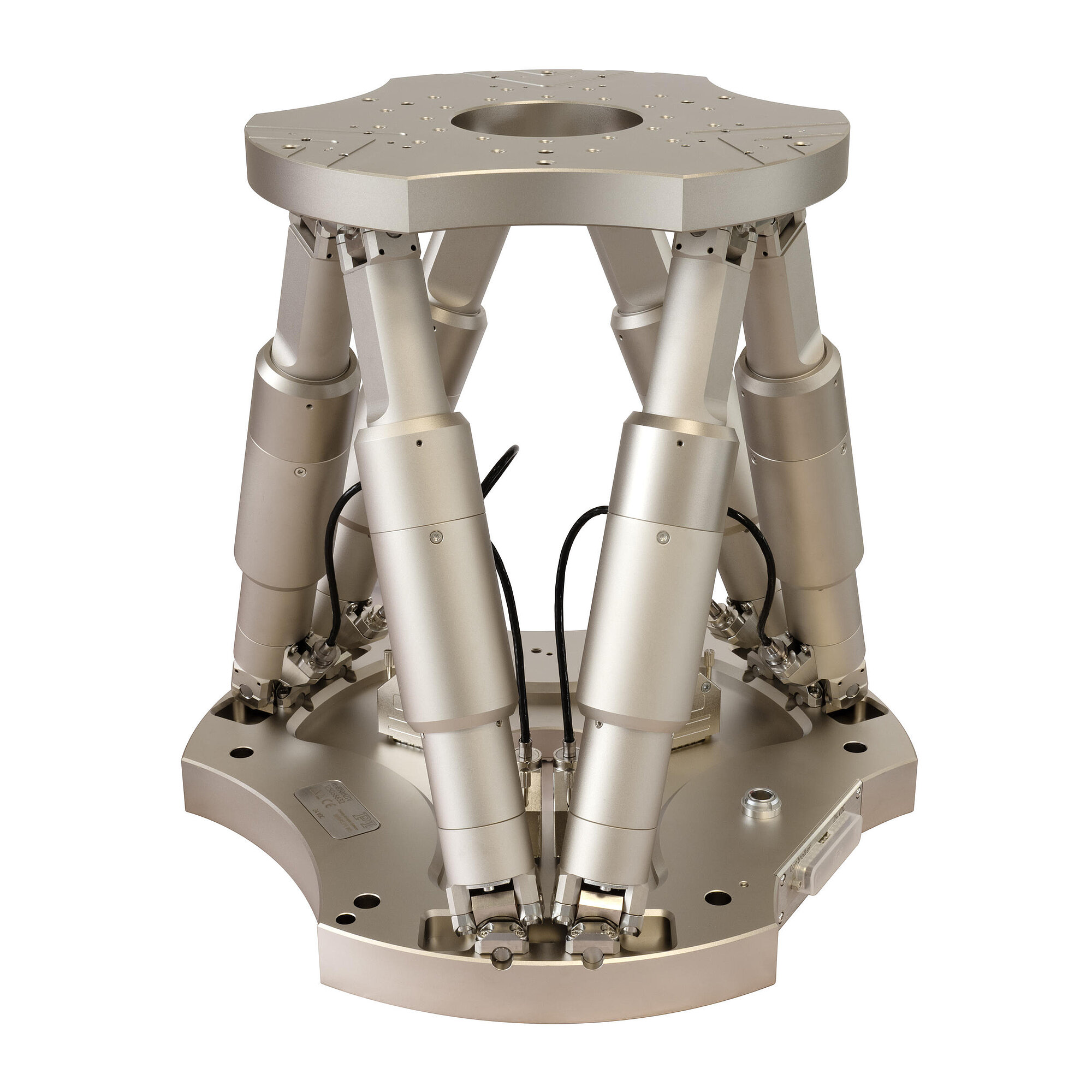
Precision hexapod; DC gear motor; rotary encoder; 25 kg payload; 2.5 mm/s maximum velocity; vacuum-compatible to 10-6 hPa; cable set 2 m on the vacuum side; feedthrough. Air-side connecting cables are not included in the scope of delivery and must be ordered separately.
H-850.x2IV Vacuum-Compatible Hexapod
For Loads to 80 kg
- Vacuum to 10-6 hPa
- Repeatability to ±0.2 µm
- Travel range ±50 mm / ±50 mm / ±25 mm
- Rotation range ±15° / ±15° / ±30°
Applications
Due to its high precision, the H-850.x2IV is ideal for positioning and aligning components in vacuum applications, offering six degrees of freedom (6DoF) with submicrometer accuracy and no disruptions to vacuum conditions.
Typical applications in industry and research include, for example, precision alignment of optical components in vacuum chambers, positioning and alignment of lithography and inspections systems, alignment of samples and beam optics in beamlines at research facilities, as well as alignment and motion of components in vacuum test chambers for satellites and optical sensors.
Precise positioning with large loads
Due to its high load capacity (80 kg) and proven reliability, the H-850.x2IV is typically used for the precise positioning of heavy test objects or samples in vacuum surroundings. The H-850.x2IV is suitable for vacuum surroundings to 10-6 hPa.
The high self-holding forces ensure excellent position stability, enabling the hexapod to maintain its position even when not supplied with power.
Parallel-kinematic design
Due to the parallel-kinematic design for 6 degrees of freedom, the hexapod is significantly more compact and stiffer than comparable serial kinematic systems. The main advantages over serial, i.e., stacked systems, are better path accuracy and repeatability. In addition, the moved mass is lower, allowing improved dynamics that are consistent across all motion axes. Cable management is also not an issue since cables do not need to be moved.
Motion simulation for protecting the overall system
The PIVirtualMove software, which can be downloaded free of charge, simulates the travel range, the alignment, and the permissible forces and torques of the H-850.x2IV to facilitate an optimum system configuration. In this context, both the chosen center of rotation and the center of gravity of the load are taken into consideration.
Work and tool coordinate systems as well as an emulation tool are included in the free software package which is part of the scope of delivery of the hexapod controller. The tools provided help protect critical components such as optical components in vacuum surroundings.
Specifications
Datasheet H-850.x2IV
Specifications
| Motion | H-850.G2IV | H-850.H2IV | Tolerance |
|---|---|---|---|
| Active axes | X ǀ Y ǀ Z ǀ θX ǀ θY ǀ θZ | X ǀ Y ǀ Z ǀ θX ǀ θY ǀ θZ | |
| Travel range in X | ± 50 mm | ± 50 mm | |
| Travel range in Y | ± 50 mm | ± 50 mm | |
| Travel range in Z | ± 25 mm | ± 25 mm | |
| Rotation range in θX | ± 15 ° | ± 15 ° | |
| Rotation range in θY | ± 15 ° | ± 15 ° | |
| Rotation range in θZ | ± 30 ° | ± 30 ° | |
| Maximum velocity in X | 2.5 mm/s | 0.15 mm/s | |
| Recommended velocity in X | 2 mm/s | 0.1 mm/s | |
| Maximum velocity in Y | 2.5 mm/s | 0.15 mm/s | |
| Recommended velocity in Y | 2 mm/s | 0.1 mm/s | |
| Maximum velocity in Z | 2.5 mm/s | 0.15 mm/s | |
| Recommended velocity in Z | 2 mm/s | 0.1 mm/s | |
| Maximum angular velocity in θX | 30 mrad/s | 1.8 mrad/s | |
| Recommended angular velocity in θX | 25 mrad/s | 1.2 mrad/s | |
| Maximum angular velocity in θY | 30 mrad/s | 1.8 mrad/s | |
| Recommended angular velocity in θY | 25 mrad/s | 1.2 mrad/s | |
| Maximum angular velocity in θZ | 30 mrad/s | 1.8 mrad/s | |
| Recommended angular velocity in θZ | 25 mrad/s | 1.2 mrad/s | |
| Positioning | H-850.G2IV | H-850.H2IV | Tolerance |
| Minimum incremental motion in X | 1 µm | 0.3 µm | typ. |
| Minimum incremental motion in Y | 1 µm | 0.3 µm | typ. |
| Minimum incremental motion in Z | 0.5 µm | 0.2 µm | typ. |
| Minimum incremental motion in θX | 7.5 µrad | 3 µrad | typ. |
| Minimum incremental motion in θY | 7.5 µrad | 3 µrad | typ. |
| Minimum incremental motion in θZ | 15 µrad | 5 µrad | typ. |
| Unidirectional repeatability in X | ± 0.5 µm | ± 0.5 µm | typ. |
| Unidirectional repeatability in Y | ± 0.5 µm | ± 0.5 µm | typ. |
| Unidirectional repeatability in Z | ± 0.2 µm | ± 0.2 µm | typ. |
| Unidirectional repeatability in θX | ± 3 µrad | ± 3 µrad | typ. |
| Unidirectional repeatability in θY | ± 3 µrad | ± 3 µrad | typ. |
| Unidirectional repeatability in θZ | ± 7.5 µrad | ± 7.5 µrad | typ. |
| Backlash in X | 8 µm | 6 µm | typ. |
| Backlash in Y | 8 µm | 6 µm | typ. |
| Backlash in Z | 1.5 µm | 0.5 µm | typ. |
| Backlash in θX | 25 µrad | 7.5 µrad | typ. |
| Backlash in θY | 25 µrad | 7.5 µrad | typ. |
| Backlash in θZ | 90 µrad | 60 µrad | typ. |
| Drive properties | H-850.G2IV | H-850.H2IV | Tolerance |
| Drive type | DC gear motor | DC gear motor | |
| Nominal voltage | 24 V | 24 V | |
| Mechanical properties | H-850.G2IV | H-850.H2IV | Tolerance |
| Stiffness in X | 3.5 N/µm | 4 N/µm | |
| Stiffness in Y | 3.5 N/µm | 4 N/µm | |
| Stiffness in Z | 50 N/µm | 60 N/µm | |
| Maximum load capacity, base plate horizontal | 25 kg | 80 kg | |
| Maximum load capacity, base plate in any orientation | 10 kg | 40 kg | |
| Maximum holding force, base plate horizontal | 250 N | 2000 N | |
| Maximum holding force, base plate in any orientation | 85 N | 500 N | |
| Drive screw type | Ball screw | Ball screw | |
| Overall mass | 17 kg | 17 kg | |
| Material | Aluminum | Aluminum | |
| Miscellaneous | H-850.G2IV | H-850.H2IV | Tolerance |
| Operating temperature range | -10 to 50 °C | -10 to 50 °C | |
| Vacuum class | 10⁻⁶ ǀ hPa | 10⁻⁶ ǀ hPa | |
| Duty cycle | 5 % | 10 % | |
| Connector for data transmission | HD D-sub 78 (m) | HD D-sub 78 (m) | |
| Connector for supply voltage | M12 4-pole (m) | M12 4-pole (m) | |
| Cable length | 2 m | 2 m | |
| Recommended controllers/drivers | C-887.5x | C-887.5x |
The duty cycle defines the hexapod's maximum permissible operating interval to be followed by a rest period, which is necessary to prevent damage to the hexapod caused by excessive heat generation. The duty cycle for continuous operation of the H-850.x2IV is defined as: the maximum duration of motion of 15 minutes at the recommended velocity. It may be necessary to restrict operating parameters during continuous operation in a vacuum due to heat generation.
Air-side connecting cables are not included in the scope of delivery and must be ordered separately.
Custom versions are available on request.
When measuring position specifications, typical velocity is used. The data is included in the delivery of the product in the form of a measurement report and is stored at PI.
The maximum travel ranges of the individual coordinates (X, Y, Z, θX, θY, θZ) are interdependent. The data for each axis shows its maximum travel range when all other axes are in the zero position of the nominal travel range and the default coordinate system is in use, or rather when the pivot point is set to 0,0,0.
At PI, technical data is specified at 22 ±3 °C. Unless otherwise stated, the values are for unloaded conditions. Some properties are interdependent. The designation "typ." indicates a statistical average for a property; it does not indicate a guaranteed value for every product supplied. During the final inspection of a product, only selected properties are analyzed, not all. Please note that some product characteristics may deteriorate with increasing operating time.
Downloads
Datasheet
Datasheet H-850.x2IV
Documentation
User Manual MS202
H-850 Hexapod Microrobot with Excellent Position Repeatability
Short Instructions MS247EK
Hexapod Systems: Hexapod H-8x with C-887.5x Controller
3D Models
H-850.x2IV 3D Model
Ask for a free quote on quantities required, prices, and lead times or describe your desired modification.
Precision hexapod; DC gear motor; rotary encoder; 80 kg payload; 0.15 mm/s maximum velocity; vacuum-compatible to 10-6 hPa; cable set 2 m on the vacuum side; feedthrough. Air-side connecting cables are not included in the scope of delivery and must be ordered separately.
Comment obtenir une offre de prix
Contactez un ingénieur!
Quickly receive an answer to your question by email or phone from a local PI sales engineer.